
AdipoGen Life Sciences
anti-IL-33, mAb (IL33068A)


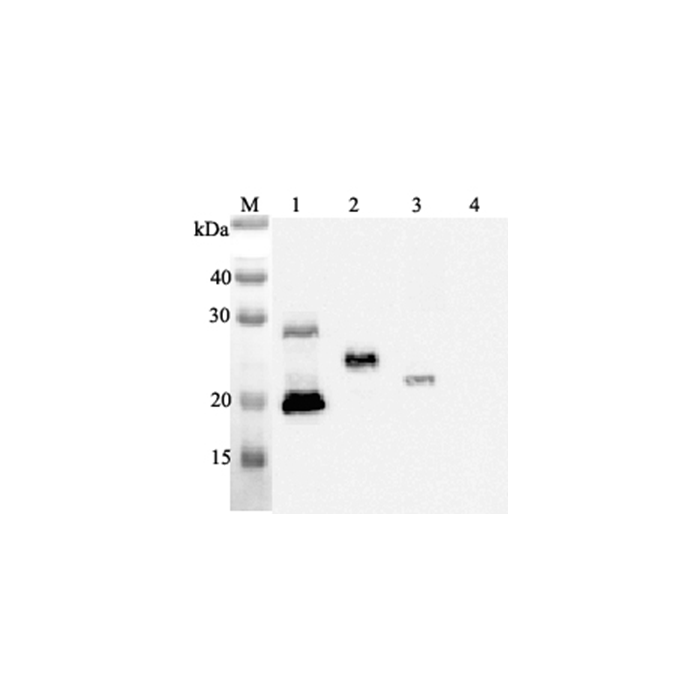
1: Human IL-33 (His-tagged).
2: Human IL-33 (FLAG®-tagged).
3: Mouse IL-33 (FLAG®-tagged).
4: Other protein (His-tagged) (negative control).
Specifications / Handling
| Product Details | |
|---|---|
| Synonyms | Interleukin-33; IL-1F11; NF-HEV |
| Product Type | Monoclonal Antibody |
| Properties | |
| Clone | IL33068A |
| Isotype | Mouse IgG2bκ |
| Immunogen/Antigen | Recombinant human IL-33. |
| Application |
ELISA: (direct or indirect: 1:2'000-1:5'000) Note: Tested on recombinant proteins and/or target-protein transfected cell lines in ELISA, Western Blot and/or FACS. |
| Crossreactivity | Human |
| Specificity |
Recognizes human IL-33. Weakly cross-reacts with mouse IL-33. |
| Purity Detail | Protein G-affinity purified. |
| Concentration | 1mg/ml |
| Formulation | Liquid. 0.2μm-filtered solution in PBS, pH 7.4. Contains no preservatives. |
| Isotype Negative Control | |
| Shipping and Handling | |
| Shipping | BLUE ICE |
| Short Term Storage | +4°C |
| Long Term Storage | -20°C |
| Handling Advice |
After opening, prepare aliquots and store at -20°C. Avoid freeze/thaw cycles. |
| Use/Stability | Stable for at least 1 year after receipt when stored at -20°C. |
| Documents | |
| Safety Data Sheet |
 Download PDF |
| Product Specification Sheet | |
| Datasheet |
Download PDF |
Scientific Background Information
Interleukin-33 (IL-33; HF-NEV; IL-1F11), a member of the IL-1 family of cytokines, is expressed by many cell types following pro-inflammatory stimulation and is thought to be released on cell lysis. The 30kDa human IL33 is converted by CASP1 to a 18kDa protein. IL33 binds to and signals through ST2 (IL1R1) and its stimulation recruits MYD88, IRAK, IRAK4, and TRAF6, followed by phosphorylation of ERK1(MAPK3)/ERK2(MAPK1), p38(MAPK14), and JNK. The ability of IL-33 to target numerous immune cell types, like Th2-like cells, mast cells, and B1 cells, and to induce cytokine and chemokine production underlines its potential in influencing the outcome of a wide range of diseases, such as arthritis, asthma, atopic allergy & anaphylaxis, cardiovascular disease/atherosclerosis, nervous system diseases, and sepsis.
-
 IL-33 (mouse) (rec.) (untagged) AG-40B-0041
-
IL-33 (human) (rec.) (untagged) AG-40B-0038
-
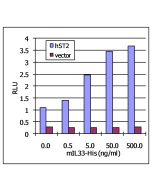 IL-33 (mouse) (rec.) (His) AG-40A-0053
-
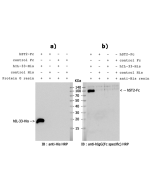 IL-33 (human) (rec.) (His) AG-40A-0042


